What Are Scope 2 Emissions?

Scope 2 emissions are indirect emissions Emissions that occur as a consequence of your activities but from sources you don't directly own or control. that a company "owns" in the sense that they result from the energy the company purchases from utility providers. In clearer terms, they include all greenhouse gas emissions released into the atmosphere from consuming electricity, steam, heat, and cooling that the organization buys.

These emissions fall under the Greenhouse Gas Protocol's The most widely used international accounting tool for measuring and managing greenhouse gas emissions. It provides standards and guidance for companies and governments. classification framework—Scope 1, Scope 2 Indirect emissions from purchased energy including electricity, steam, heating, and cooling consumed by the reporting organization. , and Scope 3—which helps businesses categorize emissions according to where in the value chain they occur. The GHG Protocol Established in 1998, it's a partnership between World Resources Institute (WRI) and World Business Council for Sustainable Development (WBCSD). is globally recognized as the standard for carbon accounting, providing a consistent methodology for measuring, tracking, and reducing emissions.

Understanding the sources of Scope 2 emissions—and how to reduce them—is foundational to accelerating an organization's decarbonization journey, since these emissions are often direct levers a business can act upon.

Unlike Scope 1 emissions, which come from sources that an organization directly owns or controls (such as company vehicles or on-site fuel combustion), Scope 2 emissions originate from off-site facilities. However, organizations have significant influence over these emissions through their energy purchasing decisions and efficiency measures.

Why Track Scope 2 Emissions?

Tracking Scope 2 emissions is crucial for several reasons. First, for many organizations, particularly in the service and technology sectors, purchased electricity represents the largest portion of their total carbon footprint. By monitoring these emissions, companies can identify opportunities for significant reductions through renewable energy procurement, energy efficiency improvements, and strategic facility management.

Second, investors, customers, and regulatory bodies increasingly demand transparency around climate disclosures Public reporting of greenhouse gas emissions and climate-related risks, often required by frameworks like TCFD, CDP, or SEC regulations. . Accurate Scope 2 reporting demonstrates environmental stewardship and helps organizations meet compliance requirements under various reporting frameworks including CDP, TCFD, and emerging SEC climate disclosure rules.

By systematically measuring, managing, and reducing Scope 2 emissions, organizations not only contribute to global climate goals but also often realize significant operational cost savings and enhanced resilience against future energy price volatility.
Forms of energy use tracked in scope 2

Scope 2 emissions refer to indirect, purchased energy emissions—those produced off-site by power providers and attributed to a company's consumption. This includes emissions from electricity, steam, heat, and cooling used within the company's operational boundary.

Electricity

This type of energy is used by almost all companies. It is used to operate machines, lighting, electric vehicle charging, and certain types of heat and cooling systems.

Because it is so versatile and foundational, emissions associated with this energy usage must be carefully monitored and optimized as part of any meaningful carbon management strategy.

☁️

Steam

Formed when water boils, steam is a valuable energy source for industrial processes. It is used for mechanical work, heat, or directly as a process medium

Combined heat and power (CHP) facilities (also called cogeneration or trigeneration) may produce multiple energy outputs from a single combustion process. Reporting companies purchasing either electricity or heat/steam from a CHP plant should check with the CHP supplier to ensure that the allocation of emissions across energy outputs follows best practices, such as the GHG Protocol Allocation of GHG Emissions from a Combined Heat and Power (CHP) Plant (2006).

🔌

Heat

Most commercial or industrial buildings require heat to control interior climates and heat water. Many industrial processes also require heat for specific equipment. T

That heat may either be produced from electricity or through a non-electrical process such as solar thermal heat or thermal combustion processes (as with a boiler or a thermal power plant) outside the company’s operational control.

⚙️

Process Emissions

Similar to heat, cooling may be produced from electricity or through the distribution of cooled air or water

Because cooling can be electrically powered or distributed as chilled air or water, it becomes a key component in energy consumption and thus contributes to a company’s indirect emissions profile. Understanding the mode of cooling—whether via mechanical chillers or through fluid distribution systems—helps clarify how cooling contributes to overall energy demand, carbon accounting, and opportunities for efficiency improvements

Why should businesses measure and reduce scope 2 emissions?

If your business or organisation purchases electricity, district heating or cooling, or steam for industrial processes - Scope 2 emissions will inevitably be created, which must be accounted for in the business' GHG inventory. However, businesses must not let this intimidate them as there are clear financial and non-financial advantages to measuring and reducing their Scope 2 emissions. Businesses who collect data, track, measure and reduce their emissions will ultimately be able to reduce inefficiencies, ensure compliance with sustainability rules and regulations, avoid carbon taxes, and boost their value to internal and external stakeholders.

Specifically, businesses that measure and reduce their Scope 2 emissions will ultimately be able to leverage the following opportunities:

Opportunity Explanation
Increased energy efficiency Businesses that prioritise sustainability through tracking and measuring their Scope 2 emissions will be able to identify areas with excessive energy usage and waste. The identification of such bottlenecks via technology such as sustainability software allows businesses to implement actions, such as switching electricity providers, to drastically reduce their energy consumption, water usage and waste; thus significantly reducing their internal costs.
Improved employee satisfaction, retention, and engagement As employees increasingly place value upon sustainability, ensuring that businesses tracking and reducing emissions is a strategic focus is critical to reaping the benefits of improved employee attraction, satisfaction, retention and engagement. Businesses that implemented a comprehensive sustainability strategy were found by Verizon to achieve up to a 13% increase in employee productivity.
Increased stakeholder trust Measuring Scope 1, 2 and 3 emissions is the backbone of any comprehensive sustainability strategy. Meanwhile, Harvard Business Review found that for a 15-year period, sustainability programs on average have increased shareholder value by $1.28 billion. As such, developing and implementing a comprehensive sustainability strategy is a fundamental step for any business looking to leverage the strategic opportunity of increased trust among internal and external stakeholders.

Nevertheless, businesses that measure and reduce their Scope 2 emissions will ultimately be able to mitigate an array of risks, including:

Risk Explanation
Increased external costs due to carbon taxes Carbon taxes pose a significant financial risk to carbon-emitting businesses - with carbon prices rising from $10.53 per metric ton in 2018 to more than $95 in February 2022. Therefore, businesses who wish to mitigate the risk of external carbon costs must monitor their emissions data and implement practices to reduce their emissions across all three scopes via actions such as switching energy providers to increase energy efficiency, or reduce fossil fuel dependence.
Fines and administrative costs due to non-compliance with ESG regulations Businesses that do not prioritise the measurement, reduction and reporting of all three emissions scopes expose themselves to immense non-compliance risk. The financial consequences of non-compliance with sustainability and ESG regulations can be severe, with OECD findings stating that fines and penalties, on average, cost $2 million. As such, businesses must ensure they are up-to-date with the latest ESG, sustainability and reporting requirements to mitigate the harmful risks of non-compliance.
Decreased revenue due to a loss of sales Consumers are increasingly prioritising sustainability when making purchasing decisions. Nielsen studies show that 72% of consumers stated they were actively buying more environmentally friendly products than they did five years ago, while 81% stated they expected to buy even more over the next five years. As such, businesses that do not prioritise Scope 1, 2 & 3 emission reduction expose themselves to the risk of misalignment with consumer values, and therefore a decrease in sales revenue.

Use Software to Manage Your Scope 2 Emissions

Using software to manage Scope 2 emissions offers significant advantages backed by real-world data. For instance, organizations utilizing emissions management platforms have reported a 167% return on investment (ROI) and a $301,000 net present value (NPV) over three years. Additionally, these tools have led to a 50% reduction in auditing costs and 60–80% time savings in data collection, validation, and reporting processes. Such efficiencies not only streamline compliance with evolving sustainability regulations but also enhance transparency and stakeholder trust

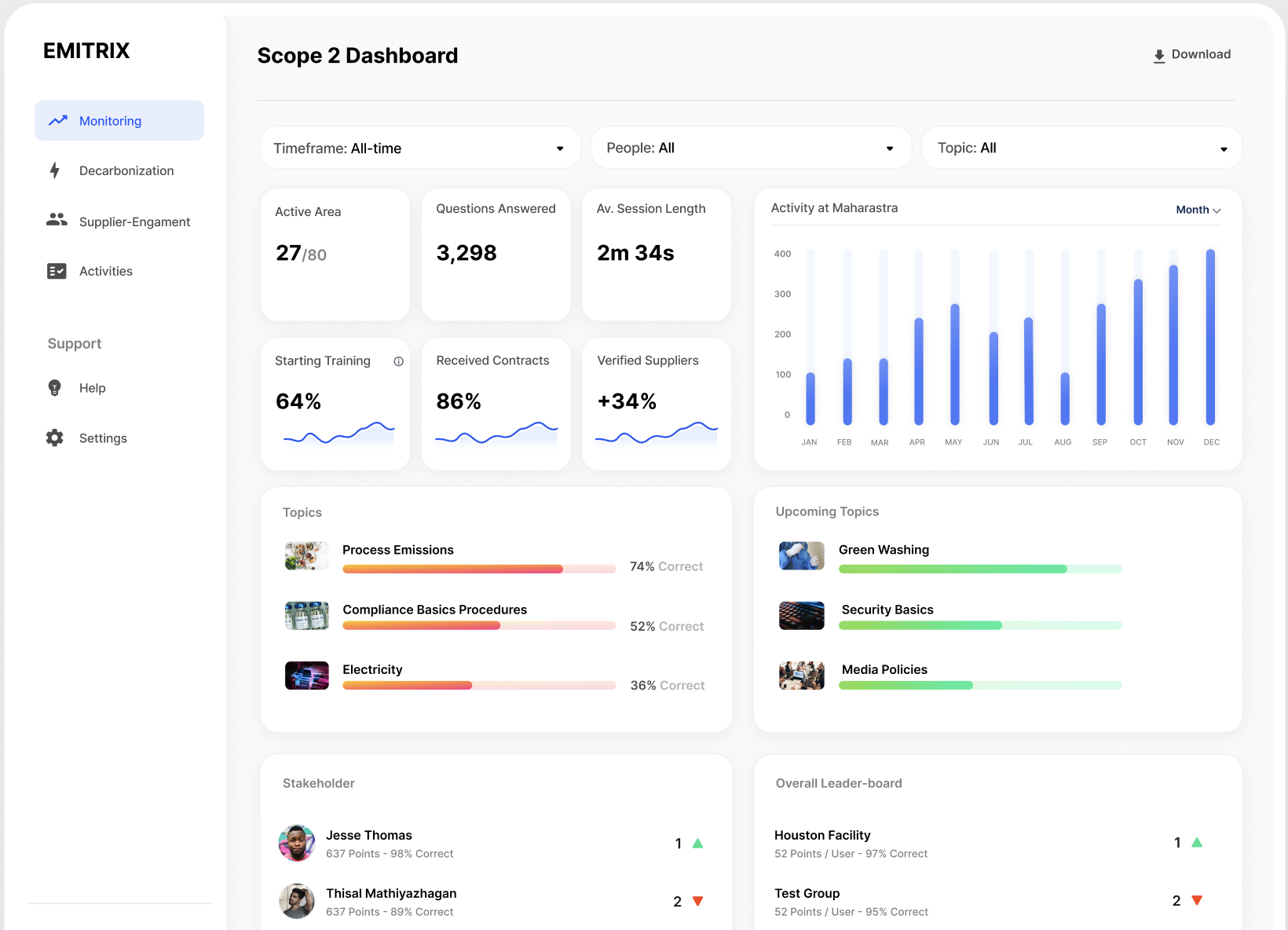
Emitrix Dashboard

Emitrix offers a purpose-built platform designed to enhance the precision, traceability, and efficiency of emissions accounting. Our solution aligns with the Greenhouse Gas (GHG) Protocol and ISO 14064 standards, enabling organizations to standardize their reporting, automate data collection and validation, and consolidate emissions data in one system.

As a provider of carbon accounting, ESG reporting, and decarbonization software, Emitrix leverages the latest scientific standards, is GHG Protocol-compliant, measure emissions across all scopes, and take informed steps to reduce their carbon footprint It facilitates end-to-end carbon management—helping organizations reduce their emissions footprint, meet regulatory expectations, and communicate transparent performance to stakeholders.

With built-in analytics and reduction tools, Emitrix offers end-to-end carbon management—helping organizations decarbonize operations and value chains, meet regulatory requirements, and transparently communicate performance to stakeholders. Our expert team in sustainability, carbon accounting, and compliance ensures clients receive strategic support throughout their journey.