
Scenario Modeling AI Bot

Scenario Modeling

Quantify climate change impacts β€” and turn uncertainty into insight.

Reachout Us
SBTi
ISO400
ISSB
GHG Protocol

How We Help You Navigate Climate Risk & Opportunities

Using scenario modeling, we translate climate uncertainty into strategic foresight.

Quantify Risk

Choose from built-in climate scenarios to model how changes (weather, policy, tech) may affect a company or portfolio.

Refine Strategy

Incorporate climate insights into your planningβ€”evaluate asset-level impact, surface vulnerabilities, and identify strategic opportunities.

Align with Regulations

Structure and report your scenario outputs to meet ISSB, TCFD, and other climate disclosure standards.
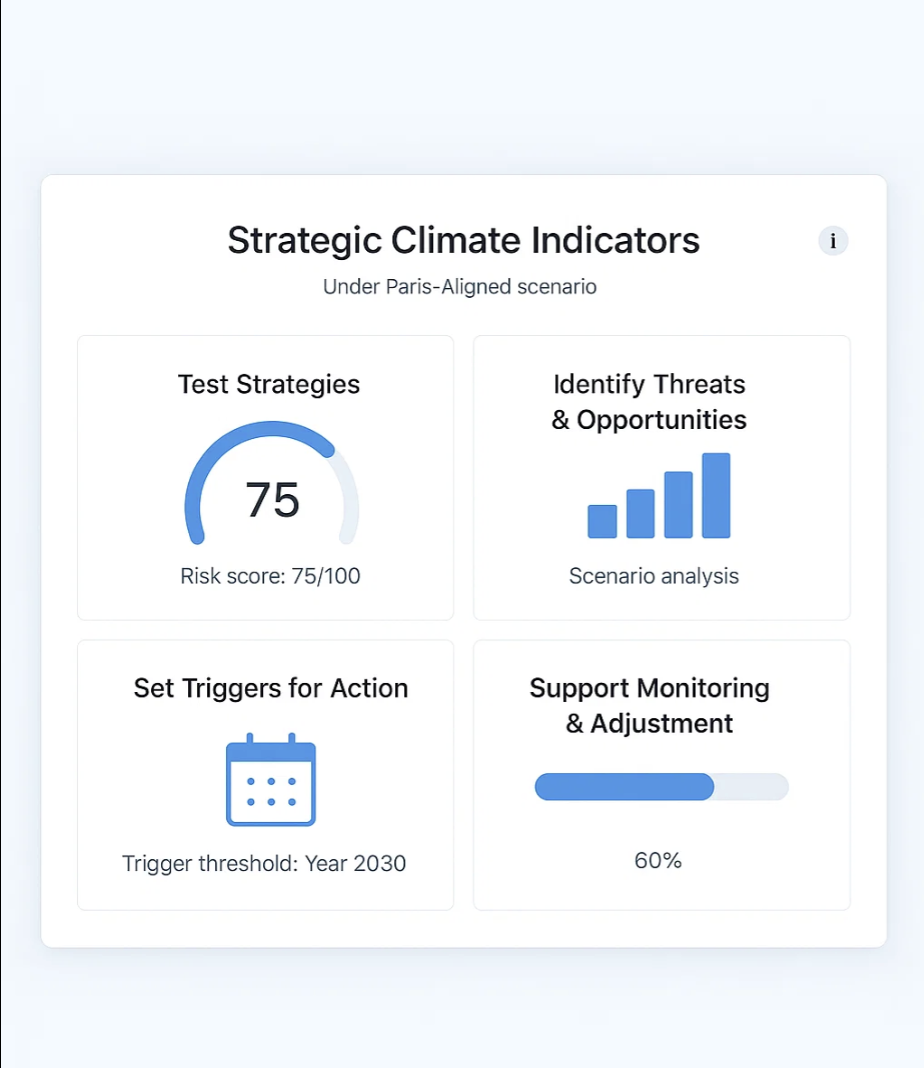
Climate Scenario Visualization

Replace with scenario charts or visualization

Holistic portfolio coverage

Calculate climate change risk and opportunity across your entire portfolio.

14,000+

Companies that can be analyzed β€” assessing their associated equities and corporate bonds for physical and transition risk

10,000+

Securities across 46 sovereign markets that can be analyzed with our stress testing models to run transition risk Climate VaR scenarios

1 million

Commercial and residential real estate properties at the asset and portfolio level that can be evaluated for transition and physical climate-related impacts

All stats as of Sept. 30, 2025

Task Force on Climate-related Financial Disclosures (TCFD)

The IPCC is the United Nations body for assessing the science related to climate change. It provides comprehensive scientific reports that evaluate the causes, impacts, and potential response strategies to climate change.

Intergovernmental Panel on Climate Change (IPCC)

The IPCC is the United Nations body for assessing the science related to climate change. It provides comprehensive scientific reports that evaluate the causes, impacts, and potential response strategies to climate change.

Scenario Modeling FAQ

Scenario modeling is a method of creating multiple plausible future states (based on different assumptions about climate change, policy, technology, etc.) to test how those futures would affect a company's operations, assets, and strategies. It’s not a prediction, but a tool for understanding risks and opportunities.
Companies undertake scenario modeling to test how robust their strategies are under different climate futures. It uncovers hidden vulnerabilities in plans when assumptions shift, helps decision makers assess the resilience and adaptability of investments, and supports transparent disclosure under frameworks like TCFD and ISSB by offering forward-looking insight.
To build meaningful climate scenarios, you’ll draw on a combination of climatic, policy, technological, economic, and asset-level data. This typically includes variables like future temperature trends and extreme event frequency; projections of carbon pricing and regulatory policies; assumptions about energy transitions and efficiency gains; macroeconomic or demographic growth forecasts; and firm-specific data such as asset locations, cost structures, exposures, and operations.
The Greenhouse Gas Protocol, developed in 2001, classifies emissions into three distinct scopes to guide organizations in comprehensive carbon accounting:
  • Stress-test strategy robustness β€”see which business plans succeed or fail under different futures.
  • Risk & opportunity mapping β€” reveal threats (e.g. asset damage) and opportunities (e.g. demand for low-carbon products).
  • Trigger points / decision thresholds β€” define when to pivot or switch strategies as certain parameters cross thresholds.
Yes β€” you can start with qualitative narrative scenarios (storylines, qualitative risks & opportunities) and gradually layer in quantitative modeling as data and capabilities improve. Many practice guides (e.g. TCFD) recommend starting simple and progressively increasing rigor.